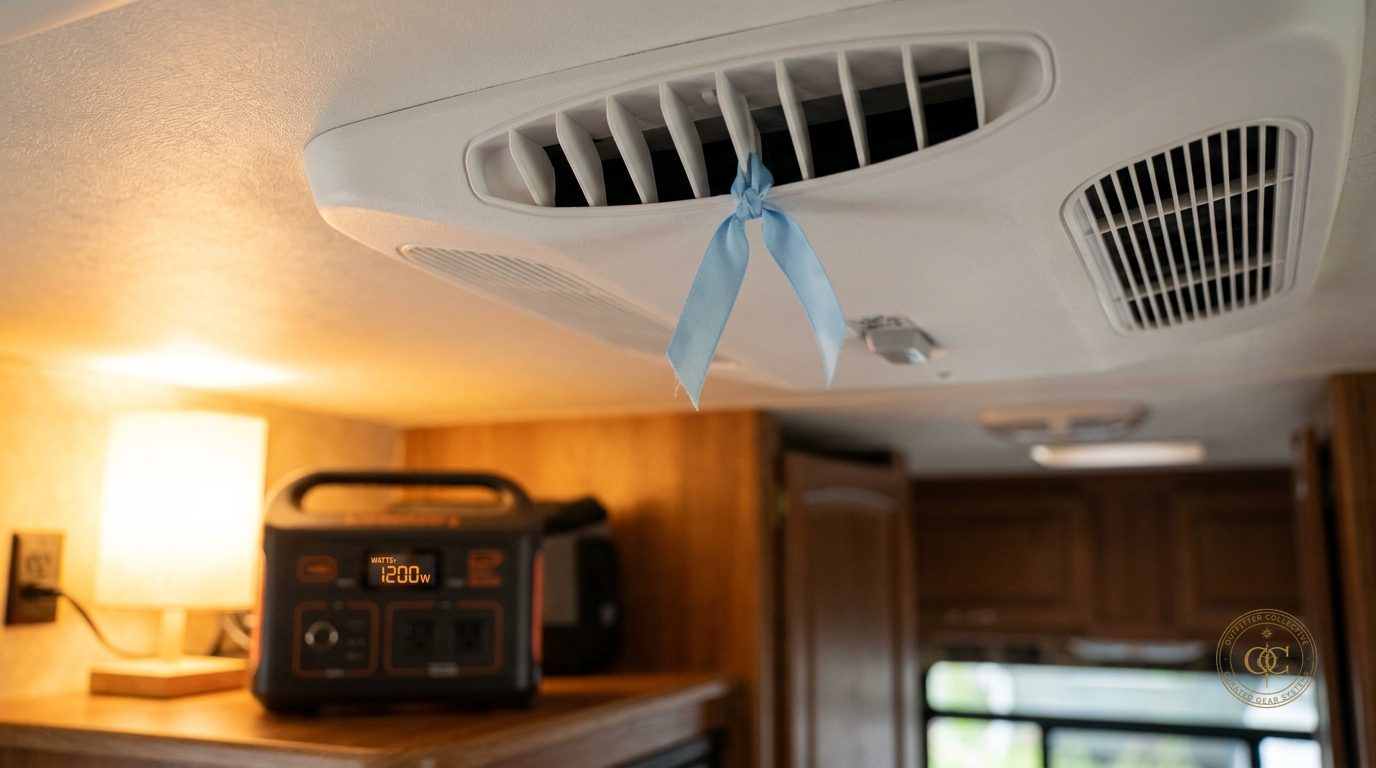
Will a Portable Power Station Run My RV Air Conditioner?
The two numbers that decide it — and the cheap fix most people never hear about.
The number on the box is the wrong number
A 13,500 BTU rooftop air conditioner runs on about 1,400W. People see that, buy a 1,500W or 2,000W power station, and it will not start. The compressor demands roughly double for a second or two as it spins up, the inverter refuses, and the unit shuts off.
This page exists because the mistake is expensive and almost universal. Get it wrong and you have spent anywhere from $300 to $3,000 on something that will not do the one job you bought it for — and opened electronics are hard to return, with restocking fees where returns are accepted at all.
There are three honest answers, in order of cost: measure what you actually draw, fit a soft start to halve the spike, or buy enough surge headroom in the first place. Most people skip straight to the third and still get it wrong.
What actually answers the question
 Starts a rooftop ACJackery HomePower 30003600W of surge headroom. A 13,500 BTU rooftop AC spikes to 2,800–3,500W for a second or two before settling near 1,400W — this is the tier that absorbs that spike without shutting down.Check price on Amazon →The cheap fixMICRO-AIR EasyStart FLEX 398 Soft Start KitCuts the AC startup surge by roughly half, which can put a unit you already own inside spec. Far cheaper than buying a bigger power station — try this before you spend thousands.Check price on Amazon →Measure firstKill A Watt Connect P4498 Usage MonitorTwenty minutes with this tells you what your loads actually draw, running AND starting. Every guide says do the math first; this is the tool that does it.Check price on Amazon →Runs the rig, not the ACJackery Explorer 1000 v2 Portable Power Station (1070Wh, 1500W)1500W handles the fridge, tools, laptops and the camp kitchen. It will NOT start a 13,500 BTU rooftop AC — and no amount of capacity changes that, because the limit is the inverter, not the battery.Check price on Amazon →
Straight answers
Will a 1,000W power station run my RV air conditioner?
Almost certainly not. A 13,500 BTU rooftop unit draws around 1,200–1,500W while running, which sounds fine — but it spikes to roughly 2,800–3,500W for a moment as the compressor starts. A 1,000W inverter sees that spike and shuts down. The battery size is irrelevant here; the inverter rating is the wall.
What is the difference between continuous watts and surge watts?
Continuous is what a unit can supply indefinitely. Surge is the brief overload it will tolerate while a motor or compressor spins up. Fridges, air conditioners, pumps, power tools and microwaves all draw far more at the instant of starting than they do running. Only one of those numbers is usually printed large on the box, and it is not the one that decides whether your AC starts.
Is a soft start cheaper than a bigger power station?
Usually by a wide margin. A soft start reduces the compressor’s inrush by around half, which can bring an air conditioner inside the limits of a unit you already own. If your only reason for upgrading is the AC, fit one of these first and re-measure before spending four figures.
How do I work out what I actually need?
Measure, do not guess. Put a meter inline with each appliance and note both the running draw and the startup spike. Add the running watts of everything you will use at once, then make sure the surge rating clears your single largest starting load. Twenty minutes of this beats every spec sheet argument on the internet.
What about charging while I drive?
Alternator charging can add several hundred watts back into the battery on a travel day and shortens the time you depend on solar. Not every unit supports it and input rates vary widely, so check that specifically if you move between sites often rather than sitting still for a week.
Where should I NOT install it?
Sealed compartments. These units generate real heat under load, and an airtight bay with no airflow shortens battery life and can trigger thermal shutdown mid-use. Give it air, especially if you are running anything close to its rating.
See the full portable power station system → · Solar charging → · How we choose →
See the full portable power system →
More Power systems
OUR PARTNERS